Posts tagged horizons of the possible
 Where difficulty thrives
Nate
:
Culture | Why computer games are a throwback to art of the past: they revive “the idea that difficulty is artistically desirable,” a critic says. “It’s a bit of an irony that difficulty thrives in the newest medium of all—and it’s not by accident, either. One of the most common complaints regular gamers make in reviewing new offerings is that they are too easy. (It would be nice if a little bit of that leaked over into the book world.)” [London Review of Books]
 Glasses for the masses
Nate
:

Some 30,000 pairs of his spectacles have already been distributed in 15 countries, but to Silver that is very small beer. Within the next year the now-retired professor and his team plan to launch a trial in India which will, they hope, distribute 1 million pairs of glasses. The target, within a few years, is 100 million pairs annually. With the global need for basic sight-correction, by his own detailed research, estimated at more than half the world’s population, Silver sees no reason to stop at a billion.
If the scale of his ambition is dazzling, at the heart of his plan is an invention which is engagingly simple. Silver has devised a pair of glasses which rely on the principle that the fatter a lens the more powerful it becomes. Inside the device’s tough plastic lenses are two clear circular sacs filled with fluid, each of which is connected to a small syringe attached to either arm of the spectacles.
The wearer adjusts a dial on the syringe to add or reduce amount of fluid in the membrane, thus changing the power of the lens. When the wearer is happy with the strength of each lens the membrane is sealed by twisting a small screw, and the syringes removed. The principle is so simple, the team has discovered, that with very little guidance people are perfectly capable of creating glasses to their own prescription.

Nate
:
Nate
:He was describing the ballet of the train station. But his description could just as easily have applied to the Internet. Think about it: Serendipitous encounters between people who know each other well, sort of well, and not at all. People of every type, and with every type of agenda, trying to meet up with others who share that same agenda. An environment that’s alive at all hours, populated by all types, and is, most of the time, pretty safe. What he was saying, really, was that New York had become the Web. Or perhaps more, even: that New York was the Web before the Web was the Web, characterized by the same free-flowing interaction, 24/7 rhythms, subgroups, and demimondes.
Nate
:Barbecuing in my sackcloth.
The turkey is smoking well. The children have gone to bed, but they’ll be up at dawn to open their presents.
The night is clear and cold. There is no moon. The light of the transmitter lies hard by Jupiter, ruby and diamond in the plush velvet sky. Ellen is busy in the kitchen fixing stuffing and sweet potatoes. Somewhere in the swamp a screech owl cries.
I’m dancing around to keep warm, hands in pockets. It is Christmas Day and the Lord is here, a holy night and surely that is all one needs.
On the other hand, I want a drink. Fetching the Early Times from a clump of palmetto, I take six drinks in six minutes. Now I’m dancing and singing old Sinatra songs and the Salve Regina, cutting the fool like David before the ark or like Walter Huston doing a jig when he struck it rich in the Sierra Madre.

Nate
: A time for branding

Nate
:Non-stupid romantic comedies
Nate
:If you were on the Internet this week you probably heard that love can no longer exist in the age of the romantic comedy. But like all cultural artifacts, while 95% of the output is rubbish, there are some real gems. I love Sliding Doors and Bridget Jones’ Diary isn’t all that bad. Next Stop Wonderland is one of my all-time favorite movies. (NYT captures it perfectly in this 1998 review.) Little Black Book is actually a weird Network-inspired satire and I’d consider Neil LaBute ’s The Shape of Things a rom-com too. To believe the genre is inherently stupid is like dismissing horror because Eli Roth makes movies.
Nate
:

Nate
:Baby on board
Nate
:
In truth, experts say, the developing world doesn’t need more incubators. It needs incubators that work. Over the years, thousands have been donated from rich nations, only to end up in “incubator graveyards” — most broken, some never opened. According to a 2007 study from Duke University, 96 percent of foreign-donated medical equipment fails within five years of donation — mostly because of electrical problems, like voltage surges or brownouts or broken knobs, or because of training problems, like neglecting to send user manuals along with the devices.
To compensate for this philanthropic shortsightedness, medical staffs either crank up the temperature in “incubator rooms” to 100 degrees or more, or swaddle babies in plastic to hold in body heat. Such makeshift solutions led the Boston team to ask: How can we make an incubator for the developing world that will get fixed? . . .
In his discussions with doctors who practice in impoverished settings, Dr. Rosen learned that no matter how remote the locale, there always seemed to be a Toyota 4Runner in working order. It was his “Aha!” moment, he recalled later: Why not make the incubator out of new or used car parts, and teach local auto mechanics to be medical technologists?
The MagnifiCat (srsly)
Nate
: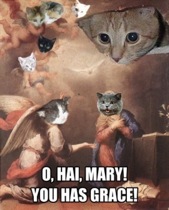
Mary sed “Ceiling Cat is laik a big deal, Mai I is happy about Ceiling Cat… bcz he kepted me in maind an now evribodi knowz i can haz cheezburgr. Thank u Ceiling Cat, u iz cool. U iz niec to evribodi. Xcept peeplz who doant dizrv it LOL. U haz pwned teh r00lrz whiel stil bein niec to teh n00bz. U givd cookies to teh hungri whiel u tolded teh rich “Niec trai.” U wuz niec to Israel an to all Abraham’s famili liek u promist.”
Nate
:Literature | How would Jack Kerouac cope with Microsoft Word? Not very well, a blogger imagines, for “the birth of the computer has led, largely, to the death of the genuine stream of consciousness novel.” It “allows us to delete, shift sections around and continually edit, in the way that Kerouac, writing on his lengthy scrolls [for “On the Road”], could not.” [Guardian]
Texting in cuneiform
Nate
:
Held in the hand, a typical cuneiform tablet is about the same weight and shape as an early mobile phone. Hold it as though you were going to text someone and you hold it the way the scribe did; a proverb had it that ‘a good scribe follows the mouth.’ Motions of the stylus made the tiny triangular indentations of cuneiform characters in the clay. The actions would have been much quicker and more precise, but otherwise rather like the pecks you make at a phone keypad.
Some tablets are of course larger. Gilgamesh, thousands of words long, is an epic in 12 tablets more than a foot high, and inscriptions carved in rock are more expansive still. But it is the small tablets with tiny writing that are the most tantalising objects in Babylon, Myth and Reality (at the British Museum until 15 March). Can one, through them, get beyond archaeological evidence and inference, bypass the fevered imagination of William Blake’s and John Martin’s Bible illustrations and hear the voice of a Mesopotamian Pepys?
Well, not exactly, but the range and character of what is written down give some idea of the texture of everyday life in Nebuchadnezzar’s Babylon. The majority of tablets may be the equivalent of office files – letters, legal documents, contracts, mortgages, lists of goods – but there are also messages addressed to the gods, some of them expressing indignance that good behaviour has not been rewarded. Astronomical observations are detailed and medical texts full of diagnostic descriptions. There are records of refurbishments: the kings, who had responsibility not just for religious ceremonies but for the maintenance of temple structures, celebrated their building works.
Nabokov on the translator’s art
Nate
:It was as if someone, having seen a certain oak tree (further called Individual T) growing in a certain land casting its own unique shadow on the green and brown ground, had proceeded to erect in his garden a prodigiously intricate piece of machinery which in itself was as unlike that or any other tree as the translator’s inspiration and language were unlike those of the original author, but which, by means of ingenious combinations of parts, light effects, breeze-engendering engines, would, when completed, cast a show exactly similar to that of Individual T—the same outline, changing in the same manner, with the same double and single spots of sun rippling in the same position, at the same hour of the day.

Nate
:Not as I do
Nate
:One surprising truth about hypocrisy is its irrelevance: the fact that someone is a hypocrite does not mean that his or her position on an issue is false. Environmentalists who litter do not by doing so disprove the claims of environmentalism. Politicians who publicly oppose illegal immigration but privately employ illegal immigrants do not thereby prove that contesting illegal immigration is wrong. Even if every animal-rights activist is exposed as a covert meat eater, it still might be wrong to eat meat.
More generally, just because a person does not have the fortitude to live up to his or her own standards does not mean that such standards are not laudable and worth trying to meet. It therefore seems that charges of hypocrisy prove nothing about a topic. Why, then, are they so potent?
The answer is that such allegations summon emotional, and often unconscious, reactions to the argument that undermine it. Such indictments usually serve as attacks on the authority of their targets. Once the clout of an advocate is weakened, the stage is set for dismissal of the proponent’s position.
Nate
:Architecture | Can you copyright an iconic building? That’s the issue raised by an expensively marbled clone of India’s Taj Majal built in Bangladesh by a wealthy filmmaker, who says he built it for Bangladeshis too poor to travel to see the real thing. Indian official: “You can’t just go out and copy historical monuments.” Bangladeshi: “Show me where it says that emulating a building like this can be illegal.” [Times of London]
Obey

Nate
:
Side 1
Alowo Majaiye
Aiye Laba Ohun Gbogbo
Rora
Gba Mi Lowo Ota
Ma Di Oni Kanra
Ile Baba MI
Side 2
Miliki
Pepeiye Bimo
Maje Nyo Aiye Wa
Baiye Nsata
Dickens on demand
Andy
:When you use a Kindle, you are not merely a reader—you are also a consumer. Indeed, everything about the device is intended to keep you in a posture of consumption. As Amazon founder Jeff Bezos has admitted, the Kindle “isn’t a device, it’s a service.”
In this sense it is a metaphor for the experience of reading in the twenty-first century. Like so many things we idolize today, it is extraordinarily convenient, technologically sophisticated, consumption-oriented, sterile, and distracting. The Kindle also encourages a kind of utopianism about instant gratification, and a confusion of needs and wants. Do we really need Dickens on demand? Part of the gratification for first readers of Dickens was rooted in the very anticipation they felt waiting for the next installment of his serialized novels—as illustrated by the story of Americans lining up at the docks in New York to learn the fate of Little Nell. The wait served a purpose: in the interval between finishing one installment and getting the next, readers had time to think about the characters and ponder their motives and actions. They had time to connect to the story.